

Board Performance · 2025
In this section15 topics
- Compliance Monitoring — Overview1 item
- Prevention of Conflicts of Interest3 items
- Prevention of the Use of Inside Information3 items
- Anti-Corruption4 items
- Whistleblowing3 items
- Selection of Directors & Chief Executives5 items
- Selection of Independent Directors2 items
- Director Development1 item
- Evaluation of Board & Subcommittee Performance3 items
- Subcommittees1 item
- Meeting Attendance & Remuneration3 items
- Supervision of Subsidiaries & Associated Companies5 items
- Board Duty Performance — Overview1 item
- Audit Committee Duty Performance1 item
- Executive Committee Duty Performance1 item
Compliance Monitoring — Overview
Compliance Monitoring — Introduction
The Company places importance to corporate governance and it has established the relevant policies and guidelines in the manual as well as encourages the implementation to build confidence in all groups of stakeholders.
In 2025, the Company has monitored the implementation of the Code of Business Conduct and Corporate Governance principles that cover important issues such as fair treatment of stakeholders, respect for human rights, fair treatment and non-discrimination for employee, promoting safety, occupational health, responsibilities to society, communities and environment, information securities, protection of personal data of relevant stakeholders as well as supervision for the transparent operation.
Although the Company’s current operations align with the Corporate Governance principles, there are certain sub-guidelines that have not yet been fully implemented, as detailed below:
Guideline 5.2.1 (3): Responsibility to Suppliers Regarding fair procurement processes and contractual terms; providing knowledge and developing the potential of suppliers to upgrade their production and service capabilities to meet standards; and ensuring that suppliers respect human rights, treat their labor fairly, and maintain social and environmental responsibility. This also includes monitoring and evaluating suppliers to foster sustainable business growth together. The Company is currently studying the development of standardized tools to ensure equitable and fair business dealings, as well as establishing mechanisms to educate and enhance supplier potential in the future to fully comply with the CG Code.
Guideline 5.2.1 (4): Responsibility to the Community Regarding the application of business knowledge and experience to develop projects that provide tangible benefits to the community, with long-term progress and success monitoring. The Company is currently exploring appropriate project frameworks to promote concrete community benefits in alignment with the CG Code principles.
In 2025, the Company continued to monitor and ensure compliance with key policies and guidelines. To achieve this, the Company developed e-learning materials and assessments covering the Corporate Governance Policy, Code of Business Conduct, Anti-Corruption Policy, Whistleblowing Policy, Insider Trading Policy, Conflict of Interest Policy, Risk Management Policy, Internal Control Policy, Corporate Social Responsibility (CSR) Policy, Privacy Policy, and other significant regulations. These key policies are also communicated through the Company’s website. The primary objective is to ensure that all directors, executives, and employees possess a thorough understanding and recognize the importance of good corporate governance, business ethics, and essential policies, enabling them to implement these principles effectively in their operations. As a result, 100% of executives and employees completed the review of these key policies and guidelines via the e-learning platform. Furthermore, all directors (100%) were informed and kept aware of these essential policies through Board of Directors meetings and electronic communications (email).
Prevention of Conflicts of Interest
Has the Company Acted to Prevent Conflicts of Interest?
Yes
Operations in the Past Year
Supervision and Prevention of Conflict of Interest
The Company places importance to consider of various transactions with transparency and benefits to the Company. Therefore, it places importance to prevent transactions that may be conflicts of interest, connected transactions or related party transactions. The Company has established a policy and practice on conflict of interest for all directors, executives and employees to sign for acknowledge and practice. The key principles are as follows:
The directors and executives must inform the Company of the relationship or connected transactions in businesses that may cause conflicts of interest.
The Company avoids to do transactions related to directors, executives or related persons that may cause conflicts of interest with the Company. If it is necessary to do such transactions, the connected transactions must be presented to the Audit Committee for consideration and suggestions before proposing for approval from the Board of Directors and/or the shareholders' meeting (as the case may be) in accordance with the regulations of connected transactions prescribed by the Stock Exchange of Thailand, the Capital Market Supervisory Board and the Securities and Exchange Commission and in accordance with good corporate governance principles. The director cannot vote on an issue where they have a conflict of interest in such agenda. The Board of Directors has established policy and procedure to ensure that the executives and related persons shall not use insider information for any personal gain.
The executives and employees must comply with the regulations and code of business conduct of the Company, which is an important matter that must be strictly adhered to create trustworthy of all stakeholders. This also includes disseminating information to ensure employees' understanding of practices throughout the Company.
In 2025, the Company followed up directors and executives to submit conflicts of interest report and has not received any complaints about the wrongdoing of directors and executives regarding the misuse of inside information or about conflicts of interest. There were no any actions that violate or breach the policy regarding conflicts of interest, as well as non-compliance with the rules of related transactions and there were no transactions between each other that may create a significant conflict of interest.
The Company requires that any party who has a vested interest in a particular transaction shall not be involved in the decision-making. The Company has established a policy which specifies rules on connected transactions and conflicts of interest as prescribed by the Capital Market Supervisory Board and the Stock Exchange of Thailand to be a practice manual (guideline) in connected transactions and conflict of interest situations. In addition, connected transactions will be reviewed and the internal audit department must report to the Audit Committee and determine the control and audit measures to ensure that the transaction is randomly reviewed and in accordance with the contract or the specified policy or condition.
The Company has a policy to disclose information about transactions that may have conflicts of interest or connected transactions or related party transactions according to the accounting standards and according to the regulations specified by the Capital Market Supervisory Board and the Stock Exchange of Thailand by disclosing in the annual registration statement and annual report.
Number of Conflict-of-Interest Cases
| Metric | Current Year | Previous Year | Two Years Ago |
|---|---|---|---|
| Total number of cases or issues related to conflicts of interest (cases) | 0 | 0 | 0 |
Prevention of the Use of Inside Information
Has the Company Acted to Prevent the Use of Inside Information?
Yes
Operations in the Past Year
Supervision of Use of Insider Information
The Company places importance of supervising the use of inside information in accordance with the principles of good corporate governance by adhering to the principles of good governance, integrity, morality and ethics in business operations. The Company has established a policy for the use of inside information to prevent and supervise the directors, executives and employees from using the Company's inside information for their own benefit or disclosing the information to other people including for securities trading. The Company also adheres to the rules and regulations of the Securities and Exchange Commission Office, such as reporting on securities trading of directors and executives. The Company has established a policy and practice on the prevention of the use of inside information for directors, executives and employees to sign for acknowledge and practice. The key points of the policy are as follows:
Inside information means information that has not yet been disclosed to the public or information that is only used for the Company's purposes and not for personal purposes including information that the Company temporarily keep to be undisclosed such as information from unpublished financial statements, dividend payment, merger, acquisition of important commercial contracts, etc.
The Company has measures to prevent the use of inside information for personal benefits as follows:
The Company will educate the directors and executives about their duties to prepare and disclose reports on their holding securities as well as the holding of their (1) spouse or cohabiting couple, (2) minor child and (3) juristic person wherein the director and executive including the persons in (1) and (2) hold shares at an aggregate amount exceeding thirty percent of the total voting shares of such juristic person to the SEC Office in accordance with Section 59 and the penalty provisions under Section 275 of the Securities and Exchange Act and to report their acquisition or disposition of the Company’s securities to the SEC Office in accordance with Section 246 and the penalty provisions under Section 298 of the Securities and Exchange Act.
The Company requires the directors and executives to prepare and submit reports on their holding securities as well as the holding of their (1) spouse or cohabiting couple, (2) minor child and (3) juristic person wherein the director and executive including the persons in (1) and (2) hold shares at an aggregate amount exceeding thirty percent of the total voting shares of such juristic person in according the specified securities holding report to the Company Secretary before submitting to the SEC Office within 30 days from the date of appointment as a director or an executive and every time of change in holding of securities or report the change in securities holding according to the specified securities holding within 3 business days from the date of purchase, sale, transfer or acceptance of such securities. The Company Secretary shall summarize and report the holding and change of the holding of securities to the Board of Directors for acknowledgement every 6 months.
The Company prohibits directors, executives and employees who have inside information of the Company to use or disclose the secret or business information of the Company for their own or other person’s benefit such as to buy, sell, offer to buy or sell, persuade others to buy or sell, offer to buy or sell securities of the Company. The person mentioned above must not disclose such information to other persons who may use that information for their own benefit especially, the business competitors whether directly or indirectly. And whether such action would benefit themselves or others or would not benefit themselves or others. This also includes using the information to compete with the Company or a subsidiary.
The Company requires that the directors and executives including those holding executive positions in the accounting or finance at the level of department director or higher or equivalent and related employees including spouses and minor children of such persons that have material inside information which may affect the stock price must suspend trading of the Company's securities in the period prior to the disclosure of financial statements or financial position and the status of the Company until the information is disclosed to the public. The company will inform the directors and executives, including those holding executive positions in accounting or finance at the level of department manager or higher or equivalent to suspend to buy, sell, offer to buy or sell, persuade others to buy or sell, offer to buy or sell securities of the Company whether directly or indirectly, and whether such action would benefit themselves or others or would not benefit themselves or others for at least 30 days prior to public disclosure and at least 24 hours after the public disclosure. Those involved in inside information must not disclose that information to others.
The Company requires directors, executives, and individuals in management positions within the accounting or finance departments at the level of Department Director and above (or equivalent), including relevant operational staff, as well as their spouses and minor children, who have access to material inside information that may impact the Company's securities price, to notify the Board of Directors or its authorized persons (the Company Secretary) of any trading of the Company’s shares at least one business day in advance.
The Company prohibits directors, executives and employees or former directors, former executives or employees who have resigned to disclosure inside information or the secret of the Company as well as confidential information of the Company's customers that they have been informed of their duties to public even though the disclosure of such information may not cause damage to the Company and customers.
Directors, executives and employees or former directors, former executives, or employees who have resigned have a duty to keep confidential and internal information of the Company and use the inside information for the benefit of the Company's business operations only. Directors, executives and employees of the Company are prohibited to use the secret or inside information of the Company for the benefit of other companies that they are shareholders, directors, executives or employees of such companies.
The Company prevents the use of inside information by limiting access to information that has not yet been disclosed to the public to only those involved and necessary, and arranging the internal information security system. The owner of the information must urge those involved to strictly comply.
Disclosure of information must be made by the authorized persons of the Company. If employees who do not have a duty to disclose the information were ask to disclose such information, they shall suggest the person who is responsible to disclose the information in order to provide accurate information in the same direction.
The Company considers that the violation of the policy on the use of inside information and unauthorized disclosure of information that cause damage to the Company and related persons are offenses that must be punished with disciplinary according to the Company's regulations. The punishments are as appropriate in the case from admonitions to dismissal and legal liability.
In 2025, there was one transaction involving the purchase of securities by a director and executive, which has been accurately and completely reported to the Office of the SEC. The implementation of the Company’s policies is accurate, complete and has no any violation of the use of inside information policy.
Number of Inside-Information Cases
| Metric | Current Year | Previous Year | Two Years Ago |
|---|---|---|---|
| Total number of cases or issues related to the use of inside information to seek benefits (cases) | 0 | 0 | 0 |
Anti-Corruption
Has the Company Acted on Anti-Corruption?
Yes
Operations in the Past Year
Anti-Corruption
The Board emphasizes transparent business conduct and anti-corruption. Therefore, it has formulated methods to prevent the Company, subsidiaries, and associated companies from engaging in corruption activities. The efforts include identifying risks of corruption, defining preventive measures, improving internal control processes, communicating internally and externally about this issue, training employees, and reviewing the process’ completeness and sufficiency.
Policy
The Board has put anti-corruption policies and measures into practice since 2019. In 2021, the Board updated them to enable the Company and subsidiaries to operate the business with transparency. Furthermore, it must never get involved with corruption, whether by demanding, accepting, or offering a bribe to government officials.
General Operating Guidelines
The Company abides by anti-corruption policies, measures, and practices as follows:
Risk Assessment : The Company assesses risks of fraud and corruption annually. The results are reported to the Risk Policy Committee, the Audit Committee and the Board. The Company then improved the internal control and operating processes to minimize potential risks and their impacts.
Guideline Establishment to Control, Prevent, and Monitor Risks of Corruption : The Company has formulated plans and operating procedures so that all departments can carry out their business activities on time and mitigate the risks of corruption.
Communication and Training : The Company providing training to the employees to promote honesty, integrity and operating guidelines for standard on good practices and code of business conduct for the employees during the orientation of the new employees. All employees can access to such information via intranet and the Company’s Website.
Monitoring and Evaluating Compliance with the Anti-Corruption Policy: In order to verse the implementation of anti-corruption policy, the Company encourages its employees and all stakeholder to report the violation of Company’s policies and unfair practices by providing the channels for stakeholders to inform any actions which are against the corporate governance principle, ethics, rules and regulations of the Company laws or any action which may cause damage to the Company to the Internal Audit Department by direct mail or E-mail as informed at the Company’s website. The Company shall protect the informant or whistle-blower by not disclosing the name of the informant of whistle-blower to any person.
Governance and monitoring of the policy compliance: The Company also communicates with employees to provide knowledge and understanding about anti-corruption measures and penalties if not complying with this measures. The Company follows up with the complaints and clues related to corruption through the specified channels to facilitate the stakeholders to send information to the Company on a regular basis.
Form of Anti-Corruption Operations
| Operation |
|---|
| Communication and training for employees on anti-corruption policy and guidelines |
| The monitoring of the evaluation of compliance with the anti- corruption policy |
| Assessment and identification of corruption risk |
| Review of appropriateness in anti-corruption |
Number of Corruption Cases
| Metric | Current Year | Previous Year | Two Years Ago |
|---|---|---|---|
| Total number of cases or issues related to corruption (cases) | 0 | 0 | 0 |
Whistleblowing
Has the Company Implemented Whistleblowing Procedures?
Yes
Operations in the Past Year
Receipt of complaints and whistleblowing handling procedures
The Company is committed to conducting business with transparency, fairness and accountability in accordance with the principles of good corporate governance. Therefore, there is a policy to report the wrongdoings (Whistleblowing Regulations) from all stakeholders. The Company has channels for directors, executives and employees of the Company and subsidiaries as well as all stakeholders, both internal and external, to report clues or complaints about wrongdoings against law, the Company’s regulations, codes of business conduct, and inaccurate financial reports and defective internal control systems of the company.
Whistleblowing Channel
Complaint box | The Company places the box in public place and convenient to file the complaints at the Company’s head office. |
Online Channel | |
E-mail to supervisor or the Company’s secretary | |
Attention: The Audit Committee Supervisor or Company Secretary Department or Human Resources Manager Address: Bluebik Group Public Company Limited 51, Naradhiwas Rajanagarindra Rd., Silom, Bangrak Bangkok 10500 |
In 2025, there was no complaints on the operation that does not comply with the law related to corruption and the code of business conduct from both internal and external parties through any channel arranged by the Company. Nevertheless, the Company continues to consistently communicate the Corporate Governance Policy, Code of Business Conduct, Anti-Corruption Policy, Whistleblowing Policy, and other essential regulations to all directors, executives, and employees. These ongoing communication efforts are aimed at fostering a culture of integrity and preventing potential complaints or whistleblowing incidents related to these matters.
Follow-up processes and management guidelines for complaints
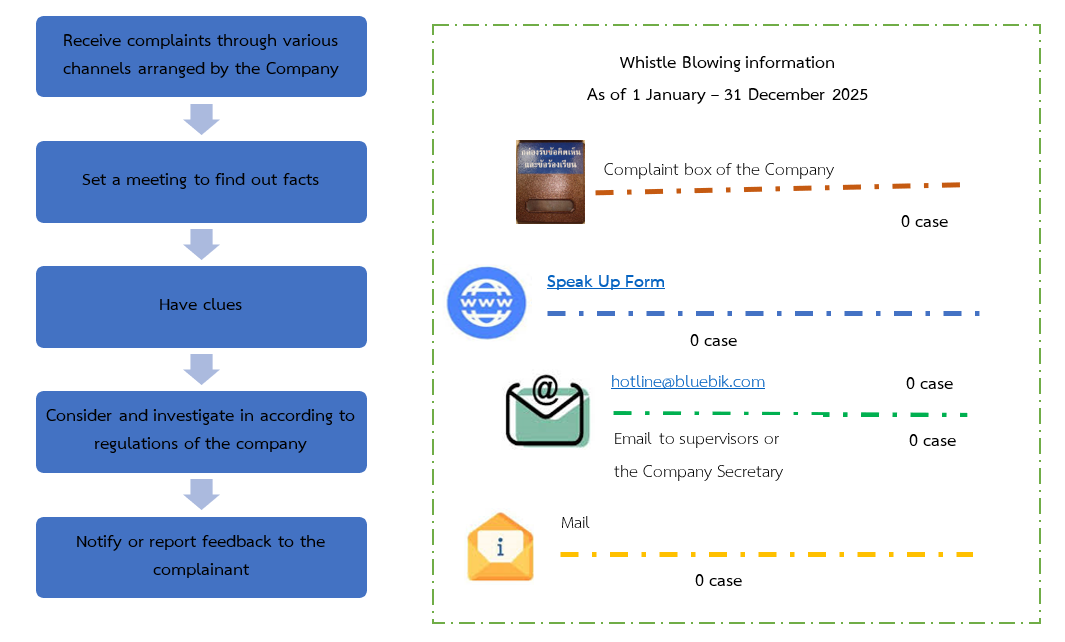
Number of Whistleblowing Cases
| Metric | Current Year | Previous Year | Two Years Ago |
|---|---|---|---|
| Total number of cases or issues received through whistleblowing channels (cases) | 0 | 0 | 0 |
Selection of Directors & Chief Executives
Directors & Chief Executives — Introduction
Nomination of Directors and Top Executives
Director nomination
The Company provides shareholders with the opportunity to nominate qualified candidates, consider individuals from the Director Pool, or propose the reappointment of existing directors for another term. In the 2025 Annual General Meeting of Shareholders, there were 3 directors who retired by rotation and there are no shareholders nominating any candidates for the directorship. The Board of Directors considered the criteria and method of nomination from the structure of the Board of Directors and scrutinized the qualifications of directors in various aspects including the performance of each director's position with prudence and caution. The Board of Directors proposed to the 2025 Annual General Meeting of Shareholders to re-elect the 3 directors who retired by rotation for another term.
In this regard, the criteria and process for recruiting independent directors are reported in Part 2 Corporate Governance, on the topic of nomination and appointment of directors and executives.
The appointed directors possess all the qualifications required under the Public Limited Companies Act and do not have any prohibited characteristics as prescribed by the laws applicable to the Company. Furthermore, they are qualified experts with no conflicts of interest with the Company. Their qualifications, knowledge, and abilities are well-aligned with the Company’s business strategies. In this regard, the criteria and process for recruiting independent directors are reported in Part 2 Corporate Governance, on the topic of nomination and appointment of directors and executives. Notably, in 2025, there were no new director appointments.
Recruitment of Top Executives
Nomination and Remuneration Committee is appointed to determine criteria and process of recruiting qualified persons to serve as top managements and nominate the appropriated persons with reasons to the Board of Directors for consideration and appointment. The recruitment process is to consider and screen candidates who are fully qualified, appropriate, knowledgeable and capable with skills and experiences that are beneficial to the operation of the Company as well as well understand the business of the Company and be able to manage to achieve the objectives and goals set by the Board of Directors.
In recruiting executives, the management has selected and nominated qualified, knowledgeable, appropriate persons with skills and experiences that are beneficial to the operations of the Company and proposed to the Nomination and Remuneration Committee and the Board of Directors for consideration. In 2025, there is no new executive to be appointed.
In this regard, the criteria and process for recruiting independent directors are reported in Part 2 Corporate Governance, on the topic of nomination and appointment of directors and executives.
Are Directors Selected Through the Nomination Committee?
Yes
Are Chief Executives Selected Through the Nomination Committee?
Yes
Rights of Minority Shareholders on Director Appointment
The right of retail investors to elect directors
Each shareholder shall have a number of votes equal to the number of shares held.
Each shareholder may exercise all the votes he or she has to elect one or several persons as director or directors. If several persons are to be elected as directors, the shareholder may not allot his or her votes to any person in any number.
The persons receiving the highest votes in descending order shall be the elected directors equal to the number of directors that the shareholders’ meeting must elect at the time. In the event that the persons who have been elected in descending order have equal votes in excess of the number of directors that the shareholders’ meeting must elect at the time, then the chairman of the meeting shall have a casting vote.
Method of Director Appointment
| Method |
|---|
| Method whereby each director requires approval votes more than half of the votes of attending shareholders with voting rights |
Selection of Independent Directors
Criteria for Selecting Independent Directors
Nomination of independent directors
In recruiting and selecting independent directors, the Nomination and Remuneration Committee will consider a person who is qualified for an independent director according to the definition of independent director set by the Company. The Company has a policy to appoint independent directors at least one-third of the total number of the directors but not less than 3 independent directors. The Company sets the qualifications of independent directors in accordance with the requirements of the Capital Market Supervisory Board. The definition of the independent directors shall be shown in section 6 “Corporate Governance”.
At present, the Company has 6 independent directors, representing 66.67% of the entire Board of Directors, consisting of (1) Mr. Thana Thienachariya (2) Mr. Vasit Kanjanahuttakit (3) Mr. Kanchit Bunajinda (4) Mr. Chalakorn Panyashom (5) Mr. Pongsuk Hiranprueck and (6) Dr. Santitarn Sathirathai. Independent directors are independent from major shareholders and management of the Company and fully qualified in accordance with the above criteria. Independent directors have no business relationship or provide professional services to the Company.
In addition, the Company has determined that the tenure of independent directors of the Company shall not exceed a cumulative term of 9 years from the date of first appointment as an independent director unless the Board of Directors deems that such person shall continue to serve as the independent director for the best interest of the Company. At present, none of independent director has cumulative term exceeding the specified term. Moreover, independent directors can call meetings as they see fit.
The Company sets the qualifications of independent directors in accordance with the requirements of the Capital Market Supervisory Board. The independent directors shall have all the following qualifications,
An independent director holds no more than one percent of the total voting shares of the Company, parent company, subsidiary, associate, major shareholders, or controlling person of the Company including the shareholding of persons related to the independent directors.
An independent director is not currently be or never been the Company’s executive director, worker, employee, salaried consultant, or controlling parties, parent company, subsidiary, associate, same-level subsidiary, major shareholders, or controlling person of the Company during the period of two preceding years. Relaxation of this requirement is in the case where the person is retired as a government official or as a consultant of a government agency which is a majority shareholder or has controlling interest for less than two years.
An independent director is not related by blood or legal registration as a father, a mother, a spouse, a sibling, a son/daughter or a spouse of a son/daughter of other directors, executives, major shareholders, controlling persons, or an individual to be nominated as directors, executives, or controlling parties of the Company or subsidiary.
An independent director does not have or never has had a business relationship with the Company, its parent company, subsidiaries, associates, major shareholders or controlling persons in such a manner that may obstruct the exercise of independent discretion. Moreover, an independent director is not or was not a significant shareholder or a controlling person of any party that has a business relationship with the Company, its parent company, subsidiaries, associates, major shareholders or controlling persons, unless such status has ended no less than two years before the date of filing.
The business relationship under the first paragraph includes any normal business transaction, rental or lease of immovable property, the transaction relating to assets or services or granting or receipt of financial assistance through receiving or extending loans, guarantee, providing assets as collateral, and any other similar actions, which results in the Company or his counterparty being subject to indebtedness payable to the other party in the amount of 3 percent or more of the net tangible assets of the Company, or above Baht 20 million, whichever is lower. The amount of such indebtedness shall be calculated according to the method for calculation of the value of connected transactions under the Notification of the Capital Market Supervisory Board governing rules on connected transactions mutatis mutandis. The consideration of such indebtedness shall include indebtedness occurred during the period of one year prior to the date on which the business relationship with the person commences.
An independent director is not or was not an auditor of the Company, its parent company, subsidiaries, associates, major shareholders or controlling persons, and is not a significant shareholder or a controlling person of the Company or a partner of auditing companies that employ auditors of the Company, its parent company, subsidiaries, associates or controlling persons, unless such status has ended no less than two years before the date of filing.
An independent director is not or was not a provider of any professional services including those as a legal consultant or a financial consultant that receives service fees of more than Baht 2 million per year from the Company, its parent company, subsidiaries, associates, major shareholders or controlling persons of the Company, and is not a significant shareholder, a controlling person or a partner of providers of professional services, unless such status has ended no less than two years before the date of filing.
An independent director is not a director appointed as a representative of director of the Company, major shareholders or shareholders related to the major shareholders.
An independent director does not undertake any business of the same nature and in competition with the Company or its subsidiaries or is not a significant partner in a partnership or is an executive director, an employee, a staff member, a consultant with monthly salary or holds more than 1 percent of the total number of voting shares of other companies which undertake any business of the same nature and in competition with the Company or its subsidiaries.
An independent director does not have any other characteristics which can compromise the expression of free views about the Company’s business operations.
In this regard, an independent director shall review and certify his/her qualifications once a year and report it with the director profile report at the end of the year for the preparation of the Annual Registration Statement / Annual Report of the Company.
Did Any Independent Director Have a Business or Professional Relationship?
No
Director Development
Director Development — Introduction
The Board of Directors and senior executives attach importance to participating in courses related to the development of knowledge and ability to perform director duties regularly. The Company's directors have been trained with the Thai Institute of Directors Association. (IOD) in courses related to the performance of director duties. 100% of the total number of directors, with IOD courses being Directors Certification Program (DCP), Directors Accreditation Program (DAP), Audit and Corporate Governance Committee Program (ACP), as well as attendances in more details, shown in detail of the director's history in Attachment 1.
Evaluation of Board & Subcommittee Performance
Criteria for Evaluating Board Performance
The Company has set in the good corporate governance policy that the Board of Directors must have self-assessment at least once a year by using the Board Self-Assessment form. This is an assessment form that is consistent with the revised guidelines of the Stock Exchange of Thailand. So, the Board of Directors can use it as a framework for reviewing the performance of its duties and jointly considering the results, problems and obstacles in the operations during the past year as well as improving and developing the performance of the Board of Directors in accordance with the established policy guidelines.
The Company Secretary shall deliver Board Self-Assessment form, both collective and individual, to all members of the Borad of Directors, which will be later returned to the Company Secretary to count the score, summarize the results and analyse the performance for the year and report to the Board of Directors for consideration to achieve the objectives mentioned above. Each director will complete the Board Self-Assessment form and return back to the Company Secretary to summarize and present the evaluation results to the Board of Directors meetings for their mutual consideration and determination of appropriateness of the board composition and reviewing the problems and obstacles during the past year. This will help the work of the Board of Directors to be more productive and it also improves the relationship between the Board of Directors and the management.
The Board of Directors has approved the Board Self-Assessment form, which has been scrunitized and approved by the Nomination and Remuneration Committee. There are 3 types of assessment forms including the Board Self-Assessment for Collective Board of Directors, the Board Self-Assessment for Sub-Committees, and the Board Self-Assessment for individual director. The criteria for evaluating the performance scores are divided into 5 levels as follows:
Score | Level |
More than 4.5 | Excellent |
More than 4.0 | Very Good |
More than 3.5 | Good |
More than 3.0 | Fair |
Less than 3.0 | Should be improved |
Evaluation of Board Performance in the Past Year
In 2025, the assessment results can be concluded that The Board of Directors performs duties in accordance with the principles of good corporate governance and good corporate governance manual of the Company as well as operates efficiently, completely, and appropriately according to the current situation. The performance results are as below.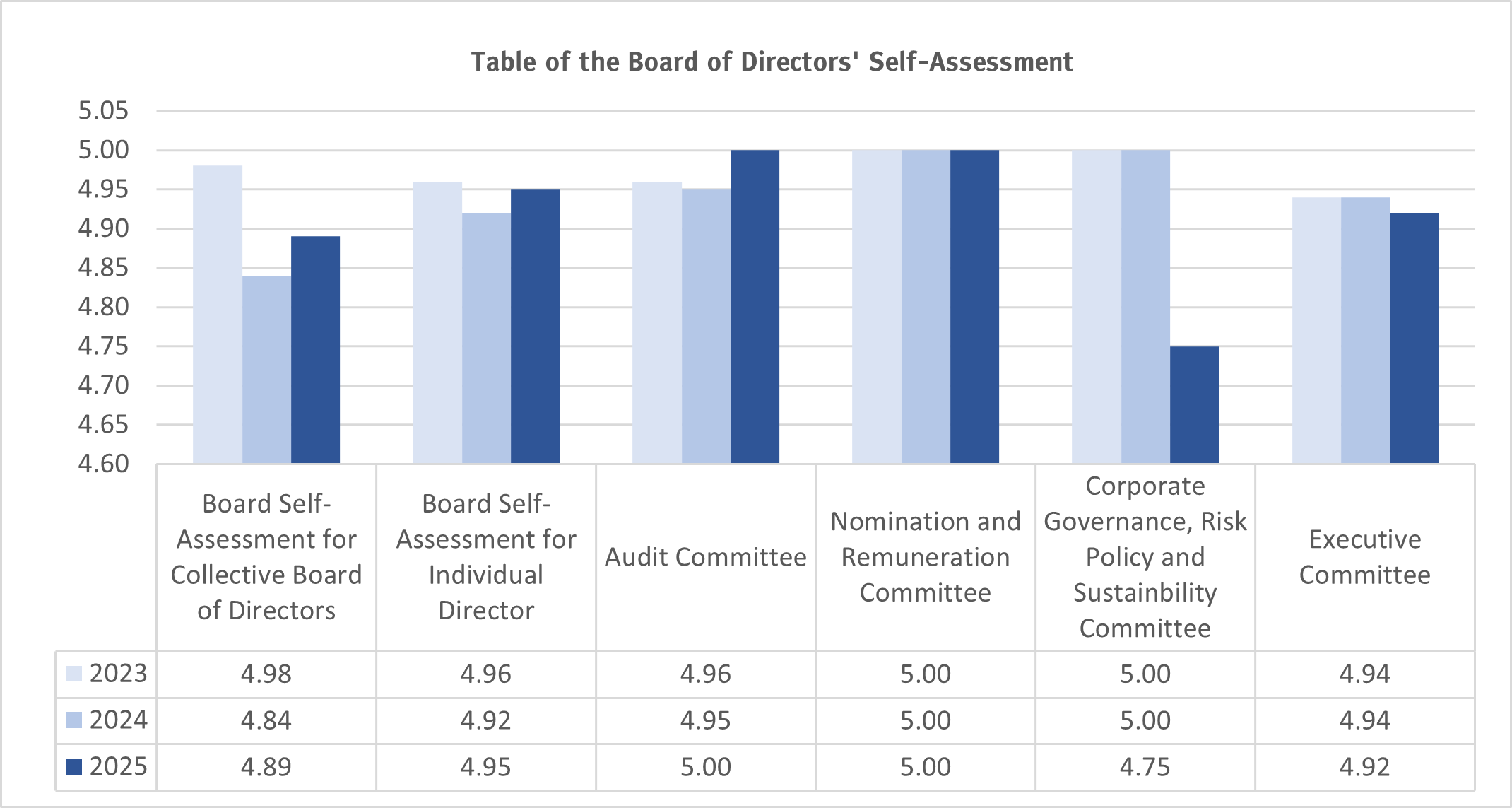
From the evaluation of the performance of the Board of Directors and sub-committees, there are comments/observations as follows:
Board Self-Assessment for Collective Board of Directors:
It was found that in the overall 6 topics, the average score was "excellent". The topic with the highest score was “the Responsibilities of Directors”. The Board of Directors has placed importance and sufficient time to consider important matters related to the strategic direction and business plan, reviewing the Company's Corporate Governance Policy and overseeing the implementation of various policies, and reviewing the Company's business ethics. The Board of Directors has established a policy to prevent conflicts of interest and regularly reviews the internal control system to ensure the sufficient internal control system, appropriate risk management as well as monitors the performance of the management's duties in accordance with the policies assigned by the Board of Directors.
Board Self-Assessment for Individual Director:
It was found that the average score was "excellent". The assessment is focus on qualifications and suitability for being a director, roles, duties and responsibilities, the relationship between the members in the committee, work efficiency and performance of duties.
Audit Committee:
Performance of the Audit Committee is sufficiently independent, which ensures that every process in operation is transparent and verifiable.
Nomination and Remuneration Committee:
The Nomination and Remuneration Committee places importance on knowledge development of personnel, directors and executives, as well as the evaluation of senior executive directors in accordance with the strategy and business plan
Corporate Governance, Risk Policy and Sustainability Committee:
The Corporate Governance, Risk Policy and Sustainbility Committee prioritizes monitoring corporate governance, code of business conduct, risk management policies and plans, supervising and reviewing the overall risk management of the Company as well as strategy used in risk management and the organization's progress toward sustainability. The Corporate Governance, Risk Policy and Sustainability Committee will report the performance results regarding corporate governance, risk management and sustainability to the Audit Committee and/or the Board of Directors on quarterly basis.
Executive Committee:
The Executive Committee perform their duty in accordance with goal, strategy, policy, objectives, the Company’s Article of Associated as well as the resolutions of the Board of Directors and the shareholders’ meeting for the best benefits of the Company.
Evaluation Results
| Evaluated Body | Group — Carried Out? | Group — Grade / Average Score | Group — Grade / Full Score | Individual (Self-Assessment) — Carried Out? | Individual (Self-Assessment) — Grade / Average Score | Individual (Self-Assessment) — Grade / Full Score | Cross (Assessing Other Directors) — Carried Out? |
|---|---|---|---|---|---|---|---|
| Board Of Director | Y | 4.89 | 5 | Y | 4.95 | 5 | N |
| Audit Committee | Y | 5 | 5 | N | N | ||
| Other Subcommittee | Y | 5 | 5 | N | N | ||
| Other Subcommittee | Y | 4.75 | 5 | N | N | ||
| Executive Committee | Y | 4.92 | 5 | N | N |
Subcommittees
Subcommittees
| Results of the Subcommittee's Duty Performance |
|---|
The Corporate Governance, Risk Policy and Sustainability Committee of Bluebik Group Public Company Limited places the highest importance on conducting business in alignment with Good Corporate Governance principles. This includes systematic and efficient risk management and control amidst constant change and the continuous expansion of the Company. Our objective is to ensure that the achievement of defined business goals while build confidence and credibility to shareholders and stakeholders. We are committed to fostering sustainable growth and development for all shareholders across the economic, social and environmental (ESG) dimensions. The Board of Directors of the Company has appointed the Corporate Governance, Risk Policy and Sustainability Committee consisting of 4 directors who have knowledge, ability, experience as well as understanding in business operations. In 2025, the Corporate Governance, Risk Policy and Sustainability Committee held 4 meetings. In 2025, the Corporate Governance, Risk Policy and Sustainability Committee followed up and considered the important assignment for the Board of Directors. The key points of the meetings can be summarized as follows:
To summarize, the Corporate Governance, Risk Policy and Sustainability Committee viewed that the Company’s business operations are fully aligned with Good Corporate Governance principles, ensuring compliance with all relevant policies, laws, and regulations. Regarding risk management, the Company maintains an effective and appropriate risk management system and framework. This enables systematic and efficient administration and control of significant risks, ensuring the achievement of defined business objectives while building confidence and credibility among shareholders and stakeholders. In terms of sustainable development, the Company’s performance has consistently met its targets and adapted effectively to changing circumstances. These efforts have been instrumental in helping the Company achieve its goals and create long-term sustainable value for the organization. |
The Nomination and Remuneration Committee of Bluebik Group Public Company Limited has performed its duties as delegated by the Board of Directors of the Company and as prescribed in the Nomination and Remuneration Committee Charter in recruiting and selecting qualified persons in according to the criteria and the process set by the Company to be nominated for the positions of directors, top level of executives, and the person with authority to manage the Company. This is also including proposing policies and measures in the remuneration and other benefits for the Board of Directors, the Sub-committees, and top level of executives. The Nomination and Remuneration Committee consists of all independent directors and no Chairman of the Board or an executive director. At present, the Nomination and Remuneration Committee comprises of 3 directors. In 2025, the Nomination and Remuneration Committee held 3 meetings. The Nomination and Remuneration Committee has followed up and considered the important assignment for the Board of Directors. The key points of the meetings can be summarized as follows:
1.1 Consider and nominate the qualified persons to replace the Directors who is retired by rotation. The Nomination and Remuneration Committee has performed its duties in according to the criteria and the process set by the Company to propose to the Board of Directors and the Annual General Shareholders’ Meeting for consideration and approval. The directors with conflict of interest will not attend the meeting and abstain from voting. In 2025, the Board of Directors gave the opportunities for minority shareholders to take part to supervise and share opinions in business operation and nominate persons to replace the Directors who is retired by rotation for 2026 in advance. The period was between 1 October 2025 to 31 December 2025 through the website of the Company. However, none of the shareholders nominated any person in nomination process in the Annual General Shareholders’ Meeting in 2026.
2.1 Consider the policies and measures of remuneration and other benefits for the Board of Directors, the Sub-committees and top level of executives for 2025 by taking into account the suitability of their responsibilities, business size, business environment, overall economic, the linkage between the Company’s operating results and overall performance and strategy and long-term goal of the Company, as well as the benchmarking against the remuneration of other listed companies in similar size and industry which is at a competitive level and reasonable. The information is disclosed in the Annual Report of the Company. 2.2 Consider and evaluate the performance of the Chief Executive Officer for the year 2024 and report the results to the Board of Directors.
The Nomination and Remuneration Committee performed its specified duties with cautiousness, prudence, transparency, and honestly and independently expressing opinions. For providing opinions and voting in the meeting, the directors with conflict of interest in the matter under consideration must be absent from the meeting and have no right to vote and provide opinions on such matter in according to the principles of good corporate governance for the most benefit of shareholders, investors and all stakeholders. |
Meeting Attendance & Remuneration
Meeting Attendance — Introduction
The Company will hold the Board of Directors’ meeting in accordance with the Company's Articles of Association, Public Limited Company Act and regulations of the Stock Exchange of Thailand, and special meetings may be held as deemed necessary. The Chairman of the Board of Directors as chairman of the meeting will encourage prudent discretion and sufficient time allocation for the meeting, so the management can present and discuss the important issues thoroughly. The Company schedules annual Board meetings at least 6 meetings per year. In each meeting, the meeting schedule and agenda is set in advance throughout the year and will be notified to the directors in advance from the end of the year before the next meeting. The Company has delivered a meeting invitation letter with clear and adequate supporting documents for each agenda item to the directors at least 7 days in advance before the meeting. The Company requires that directors are obliged to attend the Board of Directors' meetings every time except in case of necessity and there accurate and complete meeting minutes that can be verified by the shareholders.
In 2025, the Board of Directors held 6 meetings in physical and electronic meetings and the details of meeting attendance in 2025 shall be as below table.
Name | Board of Directors | Audit Committee | Corporate Governance, Risk Policy and Sustainability Committee | Nomination and Remuneration Committee | Shareholders’ Meeting | |||
Physical Meeting | E-Meeting | Total | ||||||
1. | Mr. Thana Thienachariya | 5 | 1 | 6/6 | - | - | - | 1/1 |
2. | Mr. Vasit Kanjanahuttakit | 6 | - | 6/6 | 4/4 | 4/4 | 3/3 | 1/1 |
3. | Mr. Kanchit Bunajinda | 3 | 3 | 6/6 | - | 4/4 | 3/3 | 1/1 |
4. | Mr. Chalakorn Panyashom | 6 | - | 6/6 | 4/4 | - | 3/3 | 1/1 |
5. | Mr. Pongsuk Hiranprueck | 5 | 1 | 6/6 | 4/4 | - | - | 1/1 |
6. | Dr. Santitarn Sathirathai | 5 | - | 5/6 | - | 3/4 | - | 1/1 |
7. | Mr. Pochara Arayakarnkul | 5 | 1 | 6/6 | - | 4/4 | - | 1/1 |
8. | Mr. Pakorn Jiemskultip | 6 | - | 6/6 | - | - | - | 1/1 |
9. | Ms. Sriprae Thanathitiphan | 5 | 1 | 6/6 | - | - | - | 1/1 |
Average meeting attendance (percent) | 98.15 | 100.00 | 93.75 | 100.00 | 100.00 | |||
In keeping with good corporate governance principle, in 2025, the Company arranged the non-executive directors a meeting to discuss on governance issues, business trends, risks, opportunities, and policy recommendations regarding the Company’s strategic business direction. The conclusion of such meeting has been reported to the Board of Directors or Chief Executive Officer for acknowledgement. Moreover, the meeting between directors and executives (Board Retreat) was arranged to determine business strategies and direction. This meeting also promotes good relationships between directors and executives.
Types of Remuneration of the Board of Directors
Policy and criteria on remuneration of directors
In order for the determining the remuneration of the Company’s directors to be rigorous and transparent in accordance with the principles of good corporate governance, The Board of Directors meeting No. 1/2021 held on 11 February 2021 has appointed the Nomination and Remuneration Committee to consider the guidelines for determining the remuneration and other benefits of directors, executive and the person with authority to manage the Company fairly and reasonably to propose to the Board of Directors’ meeting and/or the shareholders’ meeting for approval.
The Nomination and Remuneration Committee shall consider the appropriate structure and remuneration of the directors in accordance with duty, responsibility and motivation to drive the Company to short-term and long-term goal. The remuneration of the directors and executives shall be consistent with the long-term strategy and goal of the Company as well as experiences, obligation, scope, duty, responsibilities, and expected benefit from each director and executives. The remuneration shall be comparable with the leading ICT businesses in the same category. In this regard, the Board of Directors entrusted the Nomination and Remuneration Committee to consider and determine of the directors’ remuneration and submit such determined remuneration to the Board of Directors for reviewing prior to the submission to the shareholders’ meeting.
Remuneration of the Company’s Directors
In 2025, the Nomination and Remuneration Committee and the Board of Directors presented to the AGM to approve the remuneration of directors on 21 April 2025 at the rate of not exceed Baht 6,000,000. Details are as follows:
1. Monetary Remuneration (Remuneration as a director only)
1) Meeting allowance : which will be paid to non-executive directors based on their attendances at each meeting.
Baht per Meeting | |
Board of Directors | |
| 30,000 |
| 20,000 |
Audit Committee | |
| 20,000 |
| 10,000 |
Corporate Governance, Risk Policy and Sustainability Committee | |
| 20,000 |
| 10,000 |
Nomination and Remuneration Committee | |
| 20,000 |
| 10,000 |
Executive Committee | |
| - None - |
| - None - |
2) Bonus : The bonus (calculated from the remaining amount of approved remuneration budget) will be allocated to directors by which the Board of Directors is authorized to determine the conditions, the details, and the rate of bonus payment as appropriate together with consideration of the Company’s performance outcomes. In addition, the amount of bonus being allocated to each director is depended on the accountability, performance and the participation in the meeting. The Executive Director will not receive any director’s bonus,
3) Other benefits : None
Remark
The remuneration mentioned above applies only to non-executive directors.
The remuneration of any committee newly established during the year shall be at the Board of Directors' discretion according to appropriateness and responsibility, and the Board of Directors shall control the total remuneration to be within the amount of not exceeding 6,000,000 Baht as approved by the shareholders' meeting.
2. Other non-monetary Remuneration: None
Remuneration of the Company’s Directors
In 2025, the Nomination and Remuneration Committee and the Board of Directors presented to the AGM to approve the remuneration of directors on 21 April 2025 at the rate of not exceed Baht 6,000,000. Details are as follows:
Remuneration or Benefits Payable to the Board
| Metric | Amount (Baht) |
|---|---|
| Remunerations or benefits pending payment to the board of directors over the past year (baht) | 0 |
Supervision of Subsidiaries & Associated Companies
Does the Company Have Subsidiaries or Associated Companies?
Yes
Is There a Mechanism for Overseeing Subsidiaries and Associated Companies?
Yes
Mechanism for Overseeing Management of Subsidiaries
The Company has a policy to invest in other businesses that are beneficial to the core business of subsidiaries companies and have high potential and capability to generate profits for the Company in the long run. The Company will determine measures and mechanisms both directly and indirectly so that the Company can closely control and supervise the management of subsidiaries companies as well as monitor to ensure that the subsidiaries companies comply with measures and mechanisms in accordance with the rules governing the operations of subsidiaries companies in according to the notification of the Capital Market Supervisory Board No. Tor Jor. 39/2559 Re: Application for Approval and Granting of Approval for Offering of Newly Issued Shares (including any amendments), regulation of the Stock Exchange of Thailand Re: Listing of Ordinary Shares or Preferred Shares as Listed Securities B.E. 2558 (2015) (including any amendments) and including guidelines for good corporate governance of the Stock Exchange of Thailand (“SET”) in order to continuously and sustainably maintain the interest in the investment of the Company in subsidiaries companies as well as create value added and confidence to the Company's stakeholders. The Company has established a policy to control and supervise the policies and operations of subsidiaries companies with details as follows:
The Company has set the management structure of subsidiaries companies to supervise the management and be responsible for the operations of the subsidiaries companies as follows:
(1.1) Nomination of persons to be directors and executives of subsidiaries companies: the Company will assign its representatives approved by the Board of Directors’ meeting to be directors and executives in the subsidiaries companies to control, supervise and set the management policy as if they were business units of the Company. The number of persons who be directors in subsidiaries companies is in according to the shareholding proportion of the Company in subsidiaries companies or the mutual agreements. Such representatives must have appropriate qualifications and experiences in managing the business of the subsidiaries companies.
(1.2) The scopes of duties and responsibilities of directors and executives in subsidiaries companies are as follows:
- Closely monitor and oversee the operations of subsidiaries companies to achieve the predetermined goals of the Company.
- Perform duties as assigned by the Board of Directors of the subsidiaries companies or as assigned by the shareholders' meeting of the subsidiaries
- Consider and vote at the Board of Directors' meeting of the subsidiaries companies on matters relating to the general operations in normal business of the subsidiaries companies as the directors and executives of the subsidiaries companies deem appropriate for the best interests of the subsidiaries companies and the Company. Except for consideration and voting on the following matters that must be approved by the Board of Directors and/or the shareholders' meeting of the Company as the case may be before voting,
1) Transactions that may have material impacts on the financial position and operating results of the subsidiaries are as follows:
- Sale or transfer of the business of the subsidiaries in whole or in part that is material to other persons
- Purchase or accept of transfer of the business of other companies to the subsidiaries
- Dissolution of the subsidiaries
- Transfer or waiver of benefits and claims that are material to the damages of the subsidiaries
- Borrowing, lending, giving guarantee, incurring obligations or providing financial assistance to other companies that significantly affect the financial position of the subsidiaries
- Amendment of the Articles of Association of the subsidiaries
- Consideration of annual dividend payment and interim dividend payment (if any) of the subsidiaries
- Capital increase, allocation of newly issued shares and decrease of the registered capital of the subsidiaries as well as any other actions that result in the Company's direct and indirect shareholding in any subsidiary decrease from 10 percent of the paid-up capital of that subsidiary or decrease the shareholding to less than 50 percent of the paid-up capital of that subsidiary
- Any other transactions that are not normal business transactions of the subsidiaries and will have significant impacts on the subsidiaries
2) Transactions of subsidiaries in according to the related party transaction policy
Directors and executives of subsidiaries including related persons of the directors and executives must inform the Board of Directors of the subsidiaries of the relationship and transactions with the subsidiaries that may cause conflicts of interest and avoid transactions that may cause conflicts of interest with the subsidiaries. The Board of Directors of the subsidiary must inform the Company about such matters. The directors and executives of the subsidiary must not participate in approving the matters that they have interest or conflicts of interest.
The subsidiaries must report their business plans, investment projects, joint ventures with other operators to the Company in the monthly performance report of the subsidiaries and must deliver information or documents related to the operations to the Company if the Company requests as appropriate. In the event that any significant issues are detected, the Company may request the subsidiaries to clarify and/or submit documents for consideration. The Company will closely monitor the operations of the subsidiaries and share opinions or suggestions to the Board of Directors and the Board of Directors of the subsidiaries for consideration of policy making or improvements to support the subsidiaries' business to continuously develop and grow.
The Company must ensure that the subsidiaries have sufficiently appropriate and concise internal control systems in their business operations and also systems to continuously and reliably disclose information about significant transactions in accordance with the predetermined criteria. In addition, the Company must ensure that the subsidiaries have audit mechanisms by internal auditors and report the audit results to the directors and executives of the Company. This ensures that the subsidiaries have consistently complied with the established control processes.
Oversight Mechanisms
| Mechanism |
|---|
| Sending representatives to act as directors, executives or controlling persons in proportion to shareholdings |
| Defining the scope of powers, duties and responsibilities of directors and executives who represent the company in setting important policies |
| Disclosure of financial information and operating results |
| Transactions between the Company and related persons |
| Other important transactions |
| Acquisition or disposal of assets |
| Internal control system of the subsidiary operating the core business is appropriate and sufficient in the subsidiary operating the core business |
Agreements Between the Company and Shareholders in Managing Subsidiaries
On 5 May 2021, the Company entered into a shareholders’ agreement with Modulus Venture Company Limited, a subsidiary of PTT Oil and Retail Business Public Company Limited and established Orbit Digital Company Limited with an objective to provide consulting services including designing, developing, and maintaining systems and application for affiliates of PTT Oil and Retail Business Public Company Limited, and also monetizing data to generate new revenue stream. The important details can be summarized as follows:
Important details of Shareholders’ Agreement | |
Agreement Date | 5 May 2021 |
Parties | Bluebik Group Public Company Limited (“Bluebik”) and Modulus Venture Company Limited (“Modulus”) |
Agreement Summary | This shareholders’ agreement is essentially related to the establishment of the joint venture company to provide information technology services to PTT Oil and Retail Business Public Company Limited (“OR”) and affiliated companies and OR's customers as follows:
|
Termination of the Agreement | The Agreement is effective from 5 May 2021 until the parties have terminated the Agreement in according to the Reasons for Termination. |
Reasons for Termination | This Agreement shall be terminated upon the occurrence of the following events:
|
The Group will adopt the policy to supervise the operations in the subsidiaries and associate companies as mentioned above to supervise Orbit Digital Company Limited as well.
Board Duty Performance — Overview
Board Duty Performance — Overall Description
The Company adheres to and complies with the Principles of Good Corporate Governance for Listed Companies of the Securities and Exchange Commission (SEC) and the Stock Exchange of Thailand, as well as the criteria according to the Corporate Governance Report of Thai Listed Companies - CGR of the Thai Institute of Directors Association (IOD) continuously. However, there are some good practices that the Company has not yet applied to the business context in order to comply with the Principles of Good Corporate Governance for Listed Companies 2017 (CG Code) of the Office of the Securities and Exchange Commission, the Company has already set appropriate alternative measures.
Therefore, the Board of Directors have an important role in determining the Company's policy by working with the Executive Committee in setting values, corporate culture, vision, mission, business purpose, monetary policy, risk management, strategies, action plan and budget of the Company annually, as well as supervising to ensure that strategic plans and annual work plans consistent with the main objectives and goals of the Company. In determining the strategy and annual work plan, the environment, challenges and opportunities that affect business operations, as well as improvement in competitiveness and supervision of the adequacy of the internal control system were analyzed be strategic objectives and key strategies that the organization gives importance to.
The Company will hold the Board of Directors’ meeting in accordance with the Company's Articles of Association, Public Limited Company Act and regulations of the Stock Exchange of Thailand, and special meetings may be held as deemed necessary. The Chairman of the Board of Directors as chairman of the meeting will encourage prudent discretion and sufficient time allocation for the meeting, so the management can present and discuss the important issues thoroughly. The Company schedules annual Board meetings at least 6 meetings per year. In each meeting, the meeting schedule and agenda is set in advance throughout the year and a meeting invitation letter with clear and adequate supporting documents for each agenda item will be delivered to the directors for at least 7 business days in advance before the meeting. The Company Secretary presents the meeting schedule for the following year to the Board of Directors at the end of the preceding year as an agenda item for acknowledgment. (The 2026 meeting schedule has been tentatively set for 19 February, 12 May, 2 July , 13 August, 8 October, 122 November, and 15 December 2026, subject to change as appropriate.)
The Company requires that directors are obliged to attend the Board of Directors' meetings every time except in case of necessity and there accurate and complete meeting minutes that can be verified by the shareholders.
In 2025, the Board of Directors’ meeting held a total of 6 meetings and can be summarized as follows:
The Board of Directors is accountable for financial reporting including the Company’s separate financial statements, the consolidated financial statements of the Company and subsidiaries as well as financial information disclosed in the Annual Report. The financial statements were prepared in accordance with Thai Financial Reporting Standards by regularly implementing and conforming to appropriate accounting policies while exercising discretion, preparing reasonable forecasts and disclosing significant information in Notes to financial statements in an adequate and transparent manner.
The Company stipulates that the directors, executive directors and executives must report their own and related persons’ interests at the beginning of the positions and every change in information of their interest and report annually in accordance with the rules and procedures for reporting interests of directors and executives of the Company as prescribed by the Board of Directors. The company secretary shall submit the copy of conflict of interest report to the Chairman of the Board of Directors and the Chairman of the Audit Committee within 7 days after received.
Supervise the business operations of the Company and the management and performance of the management to be in accordance with the vision, mission, business strategy, direction of business, business policy, target, guidelines, operational plan and the budget set by the Board of Directors efficiently.
Review the strategic plan during the year, with the Chief Executive Officer reporting the actual performance compared to the established strategic goals to the Board of Directors for acknowledgment.
Supervise the internal control system and internal audit system of the Company to be sufficient and effective, including providing a process for evaluating the suitability of the Company's internal control system regularly.
The Board of Directors has established a risk management policy to ensure that risk management of the Company has a clear risk management framework and be consistent with the main objectives of the organization and be communicated to employees.
The Board of Directors has established a tax policy to ensure that the Company conducts business with an appropriated tax structure that is consistent with the transaction and conducts business with transparency, and adheres to practice according to the laws and regulations of Thailand and countries where the Company has conducted business.
The Board of Directors has established a policy to review and improve the good corporate governance policy, Code of Business Conduct for directors, executives and employees, as well as the Company's anti-corruption policy, other relating policy and the Board of Director Charter and Sub-committee Charter to be up-to-date and consistent with the Company's short-term and long-term strategic plans as well as consistent with the Principles of Good Corporate Governance for Listed Companies 2017 and Best Practice Guidelines for the Board of Directors issued by the Thai Institute of Directors Association.
In 2025, the Board of Directors has reviewed the Board of Director Charter and Sub-committee Charter, the Company's policies, directions and business strategies including reviewing the company's business goals for the year 2024, and conveying objectives and goals through strategies and plans throughout the organization through various channels such as Town Hall.
Due to our determination, adherence and strict adherence to the principles of good corporate governance, resulting in the year 2025 the company received various awards. and bring pride to the assessment results in regard to corporate governance and various awards as follows:
The Company received the Corporate Governance Report of Thai Listed Companies (CGR) for the year 2025 by the Thai Institute of Directors Association (IOD) in a Very Good criteria.
The Company scored 100/100 in the AGM Checklist of 2025 by Thai Investors Association.
The Company received SET Award of Honor – Excellence in Investor Relations in the Business Excellence category of SET Awards 2025. The Company wins the award for the third consecutive year, proving its excellence in investor relations activities. Bluebik meets criteria by providing analysts, institutional investors and shareholders with quality, comprehensive and useful business information and developing the most efficient communication channels with stakeholders. This is an important mechanism for the strength and sustainability of the Thai capital market.
Audit Committee Duty Performance
Results of the Audit Committee's Duty Performance in the Past Year
The Audit Committee of Bluebik Group Public Company Limited consists of 3 qualified directors who are independent to the management of The Company. 1 of the 3 members has knowledge and experiences in accounting. All members of the Audit Committee have all qualifications in accordance with the regulations of the Stock Exchange of Thailand (SET) and the Securities and Exchange Commission (SEC). The Audit Committee has performed its duties independently within the scope of duties and responsibilities as delegated by the Board of Directors to review the Company’s good corporate governance in accordance with the regulations and guidelines for the Audit Committee of the SEC. In 2025, the Audit Committee held 4 meetings.
The Meeting of the Audit Committee were held with the top level of executives, Certified Public Accountant (Proud in Pro Company Limited) to review financial transaction information and discuss the potential change in financial reporting standards, as well as held with Internal Auditor (Kandit Advisory Services Company Limited) and Internal Audit Unit to acknowledge the internal control system review report, share opinions and suggestions independently and present the audit results to The Audit Committee and the top level of executives for acknowledgment.
The Audit Committee reports the result of all the meeting to the Board of the Directors for acknowledgment. The key points of the meetings can be summarized as follows:
Review of Financial Statements: The Audit Committee reviewed quarterly and annual financial statements before presenting them to the Board of Directors for consideration. The Audit Committee also provided useful suggestions and opinions to ensure that the financial statements of the Company were accurate, reliable, sufficient and timely for users of the financial statements as well as in according to generally accepted accounting standards and also complied with the regulations of the Stock Exchange of Thailand and the Office of the Securities and Exchange Commission.
In this regard, the Audit Committee attended one meeting with the auditor without the management to discuss the scope, approach and audit plan, independence in performing duties and opinions of the auditor by considering the importance of accurate, complete and sufficient disclosure of information.
Review of Internal Control System: The Audit Committee reviewed the adequacy of the internal control system by considering the internal audit plan and acknowledged the audit report from the internal auditor (Kandit Advisory Services Company Limited) to assess the internal control system, risk management, corporate governance, and the credibility of financial reports.
The Audit Committee also followed up on corrective actions on material issues in the audit reports suggested by the internal auditors and the external auditors to prevent a recurrence to ensure that the internal control system was adequately managed to prevent or reduce mistakes, risks or frauds. The Audit Committee viewed that the Company had in place the appropriate and adequate internal control system for business operations and no significant flaws were found. The Audit Committee also viewed that the internal audit system was independent and the audit plan was consistent with the strategy and risks of the organization.
Review of Good Corporate Governance: The Audit Committee reviewed the appropriateness of the important policies of the Company, and reviewed the Charter of the Audit Committee to ensure that the Company had a corporate governance process that was appropriate and effective to build the confidence of stakeholders as well as to be consistent with the principles of good corporate governance.
Review of the disclosure of the information of the Company in case of entering into material transactions, Connected transactions or Transactions that may have Conflict of Interest: The Audit Committee considered material transactions, connected transactions or transactions that may have conflict of interest to ensure that such transactions were reasonable by adhering to the principles of accuracy, caution and transparency and taking into account the interests of the Company and stakeholders. The Company has a policy and guidelines for the conflict of interest, as well as ensures that the disclosure of information and process comply with the notifications of the Capital Market Supervisory Board and other relevant laws.
The Audit Committee viewed that the material transactions, connected transactions or transactions that may have conflict of interest were transparent and fair as well as maximized benefit to the Company's business operations and shareholders with normal business conditions as if they were done with third parties. For connected transactions that the size and type of transactions must be processed according to the regulations, the information was disclosed completely, accurately and sufficiently in accordance with the laws and regulations of the Capital Market Supervisory Board.
Review and Supervision of the Anti-corruption Policy: The Audit Committee reviewed the appropriateness of the anti-corruption policy and manual, and also reviewed compliance with anti-corruption policies and measures as well as acknowledged and followed up on the progress of issues that were reported through various channels including details, investigations and corrective measures taken on a quarterly basis. The Committee viewed that the Company had an effective process for reporting misconduct and fraud as well as had appropriate measures to protect complainants.
Supervision of Internal Audit: The Audit Committee considered and approved the annual internal audit plan and acknowledged the reports from the internal auditors (Kandit Advisory Services Company Limited) in the audit committee meeting. The Audit Committee also followed up progress of resolving detected issues to ensure that the executives and/or management paid attention to the management of the identified risk issues and took action to resolve the issues in a timely manner.
Consideration and Approval of the Appointment of the Company’s Auditor for the Year 2025: The Audit Committee proposed to the Board of Directors for consideration and approval at the annual shareholders' meeting for Proud in Pro Company Limited by Ms. Sansanee Poolsawat, Certified Public Accountant Registration No. 6977 and/or Mr. Theerayut Panyathaweesub, Certified Public Accountant Registration No. 6553 and/or Ms. Witita Sujitranuch, Certified Public Accountant Registration No. 7408 as the Company external auditor.
To summarize, with knowledge, capabilities, cautiousness, prudence, and sufficient independence, the Audit Committee performed its duties as specified in the Audit Committee Charter and provided opinions and suggestions for the equal benefit of all stakeholders. The Audit Committee also viewed that the Company had financial statements that were accurate, reliable, in accordance with generally accepted accounting standards, and had operations that comply with the law, obligations related to business operations, as well as had a good corporate governance system and had adequate risk management and internal control system with compliance with regulations and efficient and effective internal audit.
Executive Committee Duty Performance
Results of the Executive Committee's Duty Performance in the Past Year
The Executive Committee of Bluebik Group Public Company Limited has performed its duties as delegated by the Board of Directors of the Company and as prescribed in the Executive Committee Charter in supporting the Board of Directors on monitoring, supervising the operation of the management team in accordance with policy, strategy plan and goal including laws and regulations to promote good corporate governance. The Executive Committee consists of directors and management of the Company. At present, the Executive Committee comprises of 5 Members. In 2025, the Executive Committee held 12 meetings.
The Executive Committee has followed up and considered the important assignment for the Board of Directors. The key points of the meetings can be summarized as follows:
Perform duties within the scope of the law, objectives and Articles of Association, as well as resolutions of the Board of Directors and/or resolutions of the shareholders' meeting with duty of loyalty, duty of care, accountability, ethic, and taking into account the interests of all shareholders equally.
Determine policies, goals, business plans, business strategies and budgets including various executive powers for approval of the Board of Directors’ meetings.
Supervise and monitor the Company's performance in accordance with the policies, goals, business plans, business strategies and budgets prescribed, including various executive powers as approved by the Board of Directors to be efficient and conducive to business conditions.
Consider the annual budget and spending of budget before proposing to the Board of Directors for approval including monitor the spending of such budget in accordance with the budget as received from the Board of Directors
Review the Executive Committee Charter in 2025 to propose the Board of Directors for consideration and approval.
Implement performance assessment of the Executive Committee in 2025 to use the assessment results to improve the operation to be more efficient and to report to the Board of Directors for acknowledgement. The assessment results are disclosed in Annual Report/Form 56-1 One Report of the Company.
Prepare Report on Performance of the Executive Committee to the Board of Directors for acknowledgement and prepare the report in accordance with the regulations of the Stock Exchange of Thailand. The information is disclosed in Annual Report/Form 56-1 One Report of the Company.
The Executive Committee is committed to managing the business to achieve the vision, mission, goals, and business strategies of the organization, and managed under the principles of good corporate governance, having transparency, verifiable and fairness, while operating the business with social and environmental responsibility, for benefit of shareholders, investors and all stakeholders.